Sunday, January 10, 2016

Freiburg memories: Konzerthaus

As mentioned in yesterday's post, the Blue Bridge now leads to the Concert Hall. When the building was opened in the mid-1990s, I sang on stage. A number of the musicians I worked with had trouble participating because they had opposed the project, like quite a few Freiburg citizens who continue to oppose the modernization of the city. With some of these musicians, I also gave concerts at some protest events against the project (I was neither particularly for or against it, but just having fun making music).


Many people wanted the money devoted to better kindergartens, etc. The project was originally called the KTS (Kultur und Tagungsstätte). At some point, the name was changed, and the protesters kept the name KTS for their own counter project, which still exists in Vauban.

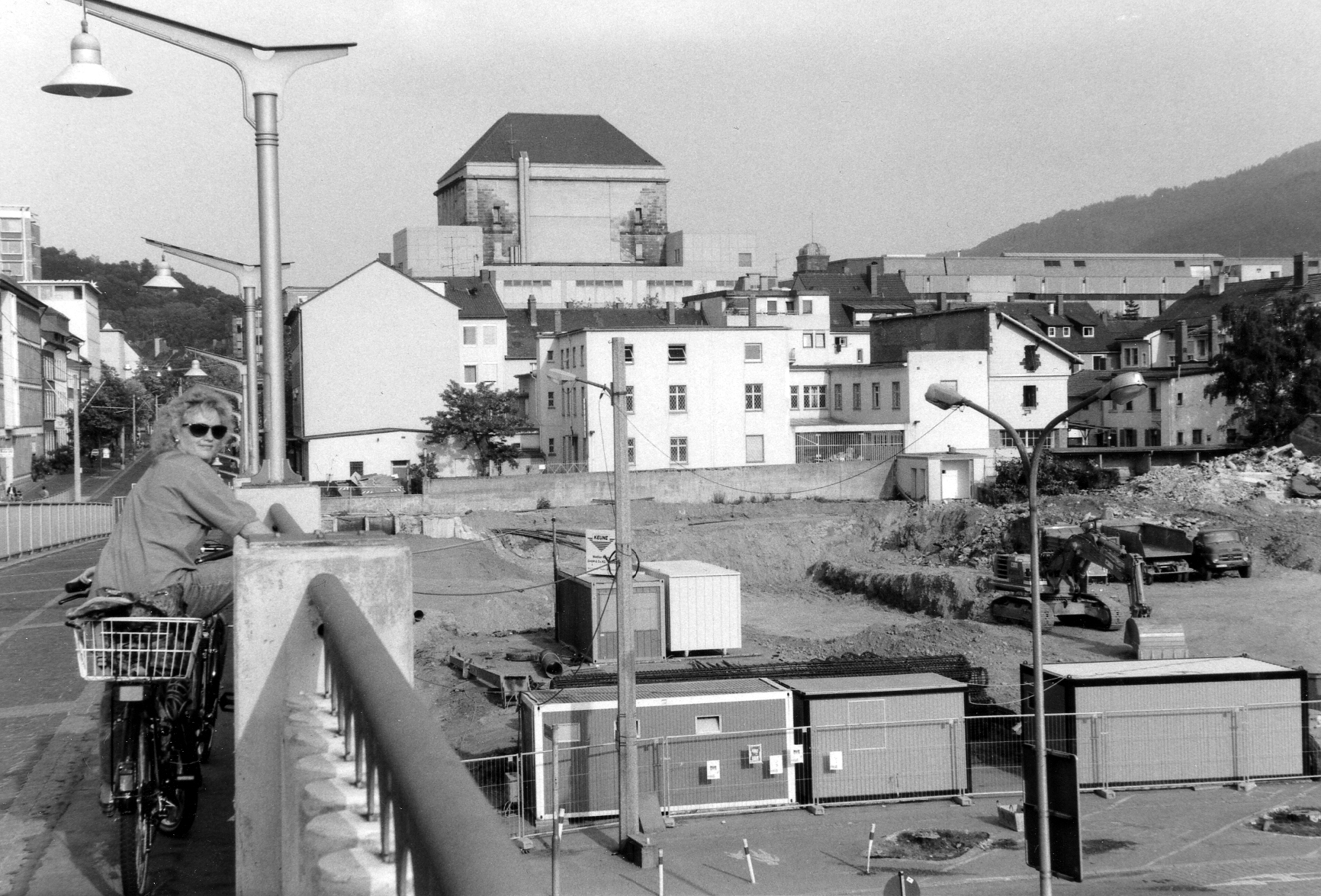
This is what it looked like when I arrived in Freiburg in September 1992 – and this was also the first thing that I saw coming out of the train station. I specifically remember it being a bunch of metal rods sticking out of the ground, so the picture must have been shot a few months before I arrived.

Friday, January 8, 2016

Freiburg memories: the Blue Bridge

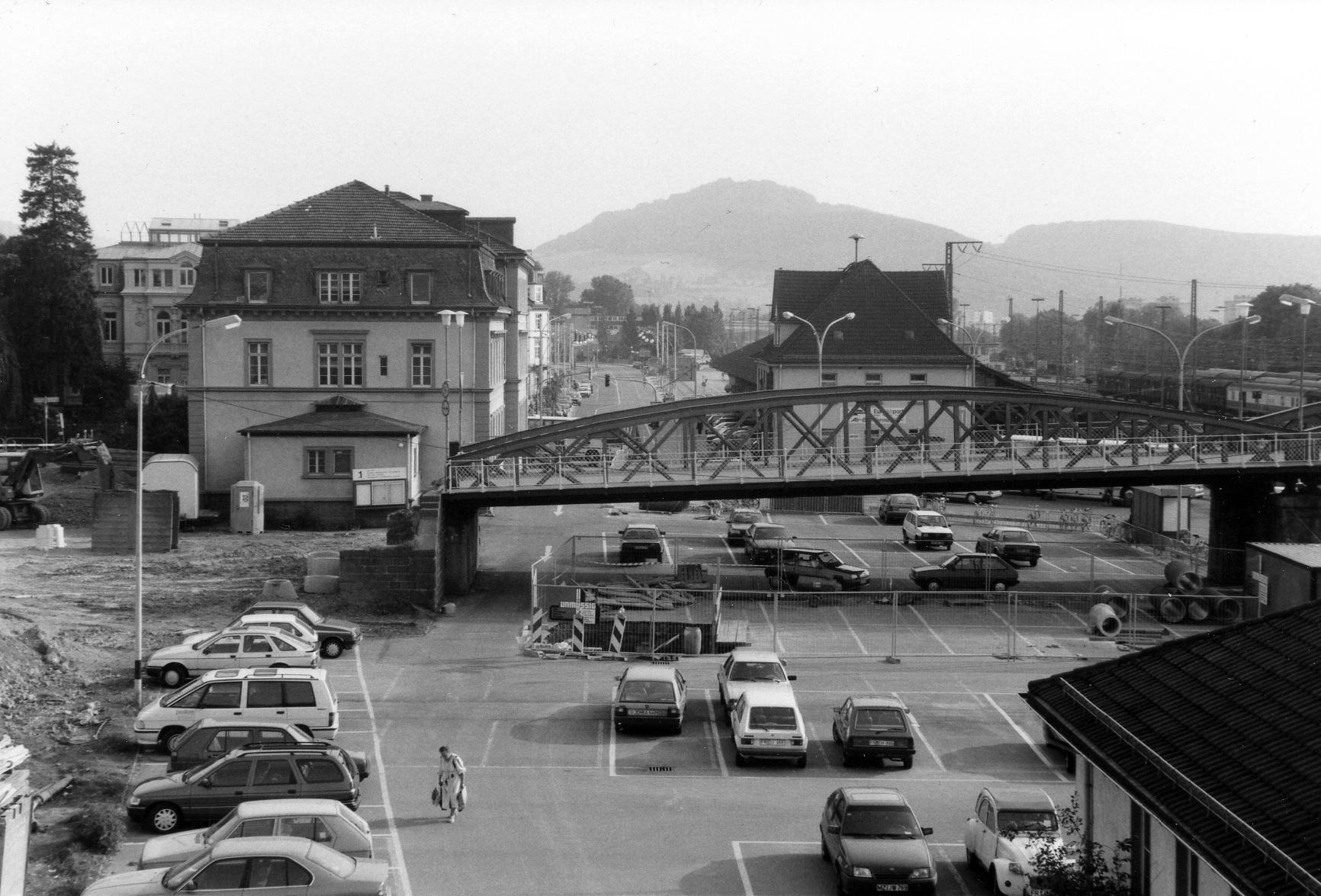
I will remember the Blue Bridge. When I moved to Freiburg, the connection for cars had just been torn down (see this photo from 1992) to make it solely a pedestrian's bridge (including cyclists, of course). It leads straight from the Sacred Heart church in Stühlinger (visible in the second photo) to the new Konzerthaus (visible in the background of the top photo), which was only just barely a construction site when I arrived in Freiburg.

Officially renamed the Wiwilí Bridge in 2003 (after Freiburg's Nicaraguan partner city), it is now a popular place for young people to hang out. The bridge crosses over the main train tracks in town (directly overlooking central station, in fact). I have been here so long that I can remember when nobody ever thought of sitting on top, much less walking up there.

When I came out of the train station, the blue bridge was one of the first things I saw – on 15 September 1992.


Thursday, January 7, 2016

Freiburg memories

This year will be my last full year in Freiburg, Germany. In the late summer of 2017, I'm moving to Berlin. By that point, I will have spent 25 years in Freiburg and the area.

I therefore like to revive this basically defunct private blog to share some photos and memories. What better picture to start with than the one I have had outside my window for the past seven years. I always wanted to have an apartment with Münsterblick. It's even nicer with the complete panorama of the city against the backdrop of the Black Forest.

This is what I woke up to this morning:


And after my shower.


Sunday, July 5, 2015

One good thing about a possible "oxi"

My dear friend Tobi posted a rant today on the Greek crisis, replete with charges of “the facts… getting completely distorted by politicians, demagogy, journalists & propaganda often viewed ideologically.”

He recommends that we watch a 40-minute video to get the real story. The link takes you to a speech given by Junker. I kid you not – to get the “real story,” we are to listen to a single person deeply involved. The next time your children get into a fight, be sure to send one of them into the next room. I’m sure the other has the whole story.

Let’s be clear about this – we are talking about people acting like children. There is blame to go around, and those who speak German can start with Harald Schumann’s video.

Tobi writes that “18 democratically elected heads of state have been negotiating for five months with the Greek government.” Actually, negotiations and been going on for years, and they are held mainly with people from the troika: the European Commission, the ECB and the IMF. The latter two are not democratically elected to office, while Commission officials are appointed by elected representatives.

The fuller story starts before Greece enters the euro zone. In the 90s, Germany wanted a currency union with Benelux and France, but France wanted Spain and Italy as well, and Italy wanted Greece. Because the Greeks did not fulfill the requirements for the euro zone, they worked with Goldman Sachs to cook the books.

The troika, especially the Europeans, justifiably resent this fraud. Less justifiably, they now aim to “teach the Greeks a lesson” for this previous cheating, as US finance expert Tim Geithner once stated. The Greek public is learning the lesson, not the Greek politicians of yore.

Maybe Goldman Sachs should chip in to rescue Greece.

Not even experts know what will happen if the Greeks vote yes or no today. Both outcomes are unclear. The Greeks cannot legally leave the euro zone, nor can they begin printing their own second currency. Likewise, the EU cannot kick Greece out of the euro zone; they can simply stop providing it with money, at which point the Greeks would have no choice but to print their own, which they cannot legally do. I therefore do not know what to hope for from the referendum today.

But the real story is that debt held by private creditors has been shifted into governmental budgets. The troika is not bailing out the Greeks; it is bailing out big banks, especially French and German ones. Bloomberg summed up the picture nicely a few weeks ago.


Yes, the Greeks need to start collecting taxes properly, especially on the rich. Towards that end, European tax havens need to hand over Greek millionaire and billionaire tax invaders. Varoufakis claims that 80 billion euros is in Swiss banks alone. (Greek debt is around 330 bn.) There’s a lot of culpability to go around.

In the end, there is no clear decision for the Greeks to make today in the referendum, and the problems are not being dealt with anyway. The Greek public is suffering inordinately; big banks are practically completely off the hook. Yet, when a lender signs a loan with a borrower, there are two parties involved. The lender specializes in loans and should not be let off the hook. Greece was a bad borrower the whole time and should not have been given this money. Private banks should have to cover defaults without passing on these losses to taxpayers. We should not bail out banks. Indeed, there has never been a time in history when borrowers were forced to pay when they could not, as we know from books like Debt: the first 5000 years and documentaries like this one. Throughout history, debt was simply canceled when it got out of hand, as it certainly is now in Greece. After World War II, German debt was reduced by around 50 percent.

These private banks are big boys and knew what they were doing when they lent money to Greece. They should have taken a haircut – but now, taxpayers will take it. The signal to banks is: be as risky as you want, losses will be socialized.

The referendum in Greece today will not solve that problem, which is the real one. A “no” vote would merely tell the world that the Greeks have had enough. The other consequences might make this option undesirable, but it is hard to know what the consequences would be. And though it is easy for me to say from Germany, 2,000 kilometers from Greece, I wouldn’t mind the Greek public saying, “Enough!”

Sunday, June 1, 2014

German "oder" = "and"


Last year, I wrote about how the Germans (mis?)use their word for "or" to mean "and." Not everyone was convinced; see the comments below these articles.

Today, I present clear evidence – a sentence from German television (the nightly news, in fact) that must've been rehearsed, had definitely been edited, was probably read off a prompter, and drew no German's attention:

"Wenn Sie oder ich das Handy der Kanzlerin abhören, dann begehen wir gemeinsam eine Straftat." (If you or I spy on the Chancellor's cell phone, we commit a crime together.)

This sentence makes no sense with the word "or"; it only works with "and." I rest my case.


Tuesday, April 1, 2014

Because I'm unhappy

Recently, political website pointed out that Pharrell Williams' "Because I'm happy" has become an extremely popular, but unlikely protest song worldwide. Last month, I also saw him on German television explaining that the idea for the song came to him when he realized how he didn't like songs that tell people they have to be happy. You know, like "Don't worry, be happy":

Your landlord says the rent is late
He may have to litigate
But don't worry, be happy

I have personally always detested that message (anybody who tells me to chill when I'm about to get kicked out of my apartment had better be able to run fast). That's really what makes Williams' message so inviting – it's not bossy. He simply asks you to "come along if you feel like that's what you want to do."

In addition to some of the "protest" versions you can view under the link above, there is the 24-hour version, a Star Wars version, and a slew of non-protest localized versions – including one from Freiburg, which made me very unhappy because we were planning to do our own.


Saturday, April 20, 2013

Willfully ignorant about race

Over at the Atlantic, Ta-Nehisi Coates recently wrote about how Americans are not in a position to speak about race because we simply do not know our own history: Americans, he wrote, "do not know, not because they are ignorant, stupid, or immoral, they do not know because they are part of country that has decided that 'not knowing' is in its interest. There's no room for any sort of serious conversation when the basic facts of history are not accessible."

A recent episode of the Daily Show is a good example. Guest Denise Kiernan has written a book about how Oak Ridge TN, a town created in the mid-1940s for the creation of material for the first atomic bomb, led to a lot of jobs for women, but remained racially segregated. Kiernan says: "after all, this was the South in 1942," to which Jon responds, "even in a manufacturing town in an integrated army." (See around minute 20.)

So here's the deal: the South was segregated like a plantation. Blacks and whites lived together but drank from different water fountains and went to different schools. We took the same buses but sat in different parts – and the whites were the ones who decided where. We did not have segregated cities. The North did

And the Army was not by any means integrated during World War II. President Truman desegregated the military forces in 1948. Elderly Germans remember being "liberated by a segregated US army" in 1945.

Americans need to accept the depth and extent of racism in its past. The North often makes itself out to be freedom fighters who opposed slavery. We have yet to come to terms with the pro-slavery demonstrations in the North, the existence of Black Codes outside the South at the beginning of the 19th century, the building codes and housing practices that effectively segregated northern cities, etc.

As Coates puts it, we are willfully ignorant.