Showing posts sorted by relevance for query guardian. Sort by date Show all posts

Friday, March 26, 2010

Interesting data from the Guardian

Since the Guardian posted some (misleading) criticism of feed-in tariffs a few weeks ago, I have been monitoring the website more closely. Today, the British paper published an interesting review of a Pew report, which found that, as the paper stresses, China has overtaken US in terms of investments in "clean tech."

But the figures used actually show how uninformed the Guardian is. For instance, the data on "clean tech" investments is linked in a table entitled "Renewable energy investment by country." But clean tech is not the same as renewable energy. Investments in carbon capture and storage, for instance, are generally also included as clean tech, as are innovative insulation systems, to name just two examples that are clearly not renewable energy. (I have not yet read the Pew report, so I do not know exactly what the study defines as clean tech.)

The Guardian then conflates "energy" with "power" when it gives us, in the same table,

  • Renewable Energy Capacity, GigaWatts
  • Percentage total power, %

We see that Brazil has made quite a lot of investments in renewables -- nearly twice as much as Germany -- but only has a third of Germany's "renewable power." Why is that? Perhaps it is because Brazil has invested so much in ethanol, which it produces from sugarcane, for use as motive fuel. In other words, Brazil produces renewable fuel more than renewable electricity. But the folks at the Guardian do not seem to understand the issue well enough to present the data accurately.


The paper then writes, "Pew have kindly shared the data with us - what can you do with it?" Answer: I would completely throw away the report in the Guardian and have to start over with the Pew data from scratch.

Also, I would have to point out something that I have said at conferences on renewables before (and it really angers people). When we count generating capacity for wind turbines and solar and compare the figure to the generating capacity from nuclear, natural gas, and coal plants, we inflate the figures for renewables. For instance, Pew reports that 36 percent of Germany's electricity generation capacity is already renewable, but the country actually gets far less than half of that percentage from renewables.

(Update: the exact figure for the share of renewable electricity was 16.1 percent in 2009 in Germany. And while the Guardian/Pew puts the figure for investments in renewables in Germany at 4.3 billion, my German source has the figure at 17.7 billion in 2009.)

The reason is quite simple -- while coal and nuclear plants run at 60-70% and 90-95% capacity, with gas turbines being switched on and off more often, wind turbines hardly ever generate more than 30 percent of their rated capacity on the average and actually come in below 20 percent in Germany. The figure is similar for photovoltaics.

Proponents of renewables get really upset when I say this, but I don't see why -- it's a simple fact. If we are going to convince the few remaining doubters, we need to speak the truth. And the truth is that wind and solar allow us to make use of a resource we lose every day - the wind and solar energy we get today. If we don't use it, we lose it.

Coal, nuclear, and gas plants are different. They run on resources we would not otherwise lose. We only lose them when we use them.

But you won't hear that from the Guardian, where the understanding of energy matters seems to be quite shallow.

Thursday, October 1, 2009

Yet another misleading article on Freiburg

I'm going to go out on a limb here and assume that this article written by someone who works for the New York Times and the international Herald Tribune is about the Vauban district in Freiburg [update: I was right]. Nowhere does she say she visited Freiburg, much less Vauban, but I know of no other part of Germany -- indeed, of the world -- that she could be talking about.

Here is the passage that is misleading:

in Germany, I’ve seen... an upscale suburb that had banned cars from its streets; you could own a car, but it had to be kept in a garage at the edge of town where parking spaces cost over $30,000 a year, meaning that few people owned cars and those who did rarely used them for small daily tasks like shopping.

Skip the fact that cars have not actually been banned from the streets altogether; she is more or less right in her synopsis. But 30,000 dollars a year for a parking space?

In fact, these parking spaces cost 16,000 euros -- not for a year, but for good. I just spoke by phone with the woman who handles the management of the Solar Garage, and she says that in addition to the purchase price of "around 16,000 euros," there are monthly service charges of "around 20 euros." Even at the terrible exchange rate of around 1.43 dollars to the euro, I still don't get much more than around 23,000 dollars for that parking space -- and again, just one time, not every year. And when these parking spaces were built, the exchange rate was much different, so if you bought one back when the dollar was worth 1.3 euros, then that parking space only cost you around 12,000 dollars, not 30,000.

The really amazing thing is that the author did not bother to find out whether these prices are remarkable in any way. They are not. You pay 16,000 euros for a parking space elsewhere in Freiburg, too. In nearby Rieselfeld, a less prestigious neighborhood, they go for something closer to 12,000 euros. But I bet you can get a parking space in the town center for closer to 20,000 euros. That's just what parking spaces cost in Freiburg. It has nothing to do with any kind of environmental thinking.

Here's the best part: this article is no better than a lot of the other stuff out there. A few years ago, the Guardian -- a quite respectable British newspaper, not a tabloid -- wrote this completely inaccurate article about these two neighborhoods of Freiburg. Here's what that guy had to say about the price of a parking space in Vauban:

Vauban residents can own a car - but they have to pay €18,000 a year to park it in one of the multistorey 'Solar Garages' on the outskirts of the quarter...

Well, at least he gets one thing right: the Solar Garage (so-called because the roof is covered with solar panels) is at the point where this new district meets the main road, i.e. where it touches the rest of town. So it is not, as our other author put it, a "garage at the edge of town" -- but on second thought, it's not "on the outskirts of the quarter" either really. It's the closest part of that district to the rest of town. And it is only a few blocks' walk away from your home. When you hear the phrase "edge of town," does that sound like you can walk to your car in two minutes?

In Vauban, you can. And on the way there, you will walk by a grocery store, a drugstore, at least one playground, at least two places to eat, and at least one tram stop that will take you to anything else you'd need to reach.

I'm not going to go further into the Guardian article (that will have to be another post) because there really are far, far too many factual errors in it. But there is one other thing wrong in the article written by our New York Times journalist -- who, to be fair, seems to be honestly open-minded. Her mistakes are probably just sloppy journalism, whereas the Guardian guy has a chip on his shoulder (but I'll get into that some other time).

The other thing that needs clearing up is this passage:

A passive house has to be under 2,000 square feet and basically box-like in order to make it energy efficient. “If someone feels like they need more than 2,000 square feet to be happy, well, that’s a different discussion,” a passive-house architect said.

Here, the exact opposite is true. The smaller the house, the harder it is to meet the passive house standard. As engineers Ludwig Rongen and Tom Nabrotzky put it at the last Passive House Conference:

Everyone who has ever dealt with energy-efficient construction knows how important a building's compactness (shape factor) is for energy efficiency.

(Disclaimer: Petite Planète translated the proceedings for that conference, so that is our translation.)

But "compactness" does not mean small. Basically, as you can see from this definition of "shape factor," the larger the "box," the less outer surface you have proportional to the heated interior volume. And the surface is where you lose the heat, ergo: the bigger the box, the better.

I'm certain that the German architect interviewed would agree with that assessment, and I think I understand what he was actually trying to say (keep in mind that he was speaking in a foreign tongue): if people want to have gigantic homes/apartments, it takes a certain amount of energy to heat up that space, so the more space you have, the more heat you need. But while it is easier to heat up a small apartment, it is also easier to heat up a large building consisting of numerous apartments than it is to heat up a bunch of single-family homes with all walls exposed to the wind.

Since 2007, I have been giving tours of Vauban (and Rieselfeld) on behalf of the City of Freiburg or acting as an interpreter with city officials when international visitors, such as urban planners from Singapore or Manchester, come by. So I know first-hand not only the history of this district, but also of its importance on the international stage. Its importance can be overstated, however. Unfortunately, its importance can also be misrepresented, not only by people with an ax to grind (like the guy who wrote in the Guardian), but also by people who actually seemed to like what they saw, like the other article.

I suppose I'll just have to come back to this with a couple of other posts on Vauban.

Monday, October 12, 2009

The Guardian on Freiburg

Before I get to my presentation of Vauban, let me first revisit this atrocious article from the Guardian from 2008 about Vauban and Rieselfeld, Freiburg's two most recently developed neighborhoods. I wrote the newspaper pointing out all of the corrections below, and an editor actually wrote me back and said he would make these changes online. But they are still up as of today, more than a year later.

Starting at the top, we have a picture of a man cleaning solar cells "at Solar World in Solar Valley, Freiburg." The problem is that SolarWorld and Solar Valley are not in Freiburg, but rather some 600 kilometers away in eastern Germany. SolarWorld does have a production plant in Freiberg (with an e), which is itself not in Solar Valley (but not far either), so maybe that's close enough for the Guardian. Kangaroos are probably from Austria, too.

Later, the author states that Freiburg was "flatten by Allied bombers in the Second World War and rebuild on enlightened, energy-saving principles," but that is nonsense. The environmental principles began cropping up around 1990, decades after the city had been completely rebuilt.

Things get much worse from there. Proving that a little bit of knowledge is worse than none at all, the author writes that Vauban reminds him of Le Corbusier (a consultant for the UN building in New York), but he obviously has no understanding of what Le Corbusier stood for (take a look at this baby and compare it to this picture taken by a Brit). The problem with that style of architecture was that it was too large for people to manage. You could walk for several minutes and never reach the end of your building, and shops were too far away.

While the author is right in saying, "Because the properties are all the same age, the place lacks character and charm," that does not mean that the buildings do not have a human dimension. It simply means the development is new. You could make such claims about any new project, and indeed I see the following complaint about Prince Charles' Poundbury project: "The controversy over Poundbury has been dominated by its looks." Anyway, as in Poundbury, in Rieselfeld and Vauban, you can go downstairs and walk to the end of your building in about 50 yards. The next shop is probably only a minute away. Not Corbusier.

As one British expert described Vauban and Rieselfeld, "While the blocks tend to be similar in height and footprint, each block looks individual because of the rich variety of materials and colours that are used."

The Guardian author doesn't seem to realize that his own article demonstrates that Vauban/Rieselfeld is a rejection of Le Corbusier:

'From the top floor of every house,' says Daseking, 'parents had to be able to shout to their children in the garden - and hear the reply. It was important to get in touch with the ground.' This limited the height of buildings. To reduce theft, small garages (for those who wanted cars) were built every two blocks, rather than large ones every five blocks. 'From every corner, you could see what was happening in your garage,' says Daseking. 'Criminality had to go down.'

The author then manages to find a resident who argues that "there is little support for a car-free system," which "people don't really accept." I was surprised to read that -- first, because I know a lot of people who live there, and none of them have a problem with the system; and second, because it was the citizens themselves who forced the city to get all the parking spaces away from the houses. When reading this Guardian article, you would think it's the other way around -- it sounds as though a bunch of radical city officials are trying to force residents to do without cars, but in fact the opposite is true.

The car co-op that forced the city to allow people to do without adjacent garages is currently pursuing three cases of people having relatives register their cars, which are then parked down the street. Some 4,500 people live in Vauban, i.e. almost 3,000 households. That sounds like near 99% compliance.

As I have said before, a parking space in the community garage costs 16,000 euros to purchase, not 18,000 euros a year -- but I have talked about that enough. The 18,000 euro figure comes from a clause in the Land Registry, which ties each particular apartment to a parking space, even if the residents have opted out because they do not have a car. In other words, if you sell your apartment and do not have a parking space, you pass on the obligation to the buyer, and the debt is estimated at 18,000 euros in the Land Registry.

The journalist also does not seem to know the difference between photovoltaic solar panels, which generate electricity, and solar heat collectors, which heat up water, when he writes:

These 'collectors' don't heat the properties themselves, since Vauban is supplied by a small local power station, but they feed energy back into the regional grid to make their owners a modest income.

And when he later writes, "the homes also have solar collectors capable of feeding more energy into the grid than they waste," he can only mean "consume" where he writes "waste."

He then finds a resident named Stefan who claims that, if he changes his mind about having a car, "they can take part of our property." I called Stefan to ask whether he said that in whether he stands by the factually inaccurate statement; you can by a car any time you want, but you just have to buy a parking space in the garage then. He pointed out the passage in the Land Registry -- that is what he meant.

Stefan says that he knows of three people with campers that don't fit in the garage. They indeed parked outside of the neighborhood, but apparently an agreement has been reached for such extra large vehicles.

While some of the other local people in the article were incensed by the report, Stefan said it did not upset him. He especially liked the last sentence in it, where the British author points out that Germany is "decades ahead" of the British in terms of citizen involvement in urban planning. And Stefan swore that he did not get drunk with the British journalist and does not know why the man wrote about 12 turbines when there are only six: "on a pine-covered mountain overlooking Vauban, I spot a dozen giant wind turbines."

Stefan also confirmed my personal impression from the people I know in Vauban that there is very high acceptance of the restrictions on cars. He says he personally picked up the British journalist in a co-op car -- a fact the journalist does not mention, though we do read all kinds of negative aspects, such as that people do not like to do without cars, that the city did not get the demographics right, that Stefan's bike was stolen, etc. Nowhere does the British journalist tell us that all of the people he interviewed think the place is fantastic.

Overall, Stefan says he told the British journalist up front not to get his hopes up too high because "Vauban and Rieselfeld" are really quite normal -- a sentiment I would completely support. Nonetheless, the British author seems to have been collecting dirty laundry and trying to be facetious:

  • "Like all good Germans, Claudia recycles"
  • "It sounds extreme, but Rieselfeld is a fairly extreme place"
  • "With his shaved head, bomber jacket and shades, he looks every bit the fortysomething communard." (This was said about a man who volunteered to show the journalist around for an hour at no charge.)
  • "It's a brave utopian vision" (that doesn't sound normal to me)
  • "Vauban, the radical car-free quarter" (not car-free, but whatever)
  • "'This is our local Conflict Resolution Workshop,' says Barbara, without a trace of humour, 'which does a lot of work with migrants'"
  • "SUSI - a radical housing association"

Stefan was also surprised to read that he apparently said the following: "some enraged residents have smashed up cars left on the street." When I called him, he said, "Nothing of the sort has happened over here, and I never said that. People leave messages under your windshield wiper asking you to move your car, but otherwise I have only heard of one case of a tire being slashed" -- something that, admittedly, can happen anywhere. Again, Vauban and Rieselfeld are normal.

Fortunately, I have toured these neighborhoods with other Brits and know what the British generally think about Vauban and Rieselfeld. One cameraman from the BBC stood in amazement in one of the passive houses and remarked, "You couldn't get an Englishman to install an airtight window." (Passive houses undergo blower-door tests.) And British urban planners (from Manchester, London, and Guildford) say they simply do not have the flexibility to allow for such citizen input; rather, they have to accept the cheapest schemes from large housing associations.

In my experience, the British reaction is closer to what this blogger wrote:

The list of achievements at Rieselfeld is almost endless and mind-boggling; from a UK perspective, it would be remarkable to achieve but a few of these.

Finally, the British journalist complained about the food, which is simply going too far:

... the 'vegetarian curry' was an abomination: rice with a tin of apricots emptied over it, topped with a heap of overcooked Brussels sprouts.

Sorry, buddy, but I have spent enough time in England to know what the food's like. And I have taken out a number of British visitors to Freiburg, and they were all completely blown away by what I consider to be absolutely run-of-the-mill Freiburg cuisine. One meal at one café does not an overview make. (Though I agree that that café is crappy.)

"The two settlement extensions of Riesefeld and Vauban are so different from anything yet attempted in Britain," wrote an expert in London, that "it is easy to dismiss them as interesting but irrelevant. Yet they tackle some basic issues that apply equally to British cities, including how to attract families to live at high enough densities, and close enough to city centres to avoid depending on the private car, and this they do extremely well." Nuff said.

Saturday, November 14, 2009

The Guardian got it right! Almost...

The Guardian has published another article on Vauban, a Freiburg neighborhood considered progressive in many respects but largely misrepresented. But this author does not make any mistakes in his admittedly brief presentation.

He also points out that other car-free districts often physically prevent you from driving up to your front door, which is only an inconvenience. Why should I not be able to transport a new fridge by truck or a giant load of groceries by car?

Unfortunately, the Guardian also references a laughable previous article it seems to be proudly sticking to. I dissect it here.

Thursday, July 22, 2010

Yes, the Guardian again...

The Guardian writes:


The world's first molten salt concentrating solar power plant
'Archimede' demonstration solar plant in Sicily becomes the first to use molten salts to store energy overnight


Here's Wikipedia on Solar Two from 1995:

Solar Two used molten salt, a combination of 60% sodium nitrate and 40% potassium nitrate, as an energy storage medium instead of oil or water as with Solar One. This helped in energy storage during brief interruptions in sunlight due to clouds. The molten salt also allowed the energy to be stored in large tanks for future use such as night time.Solar Two proved it could run continuously around the clock producing power.

[Update: Carlo, the author, responds. It's the Guardian's fault, not his ;-) I'm not surprised.]

Thursday, June 3, 2010

The Guardian gets more facts wrong

I grow weary of fact-checking for the Guardian, but in an otherwise fascinating article about oil spills in Nigeria, we find the following inaccuracy:

... the Niger delta supplies 40% of all the crude the United States imports and is the world capital of oil pollution.

That's blatantly wrong, as you can see from the official statistics from the US government here. Nigeria as a whole provides closer to 7-8 percent of all the crude the United States imports. The Niger Delta is entirely within Nigeria, so there is no other country that contributes to the figure for crude from the Niger Delta.

Overall, Nigeria is far behind Canada (in first place) and Mexico (generally in second place) as a crude supplier to the US. Nigeria generally vies for third place with Saudi Arabia and Venezuela.

The unfortunate thing is that when you see such an obvious inaccuracy, you doubt the rest of the article.

Friday, July 16, 2010

Another brainless article at the Guardian

The Guardian has published another completely misleading article, this time conflating "solar power" with concentrated solar power. The former is simply any electricity generated from solar energy (photovoltaics and solar thermal), whereas the latter are only systems that use solar heat to boil water to drive a conventional turbine (no photovoltaic cells are needed).

The author himself seems to have no idea what he's talking about when he writes:

Last year, solar energy met 2.8% of demand out a total of 12.9% for all renewables.

The author puts the figure or CSP at just over 400 MW, whereas Spain has around 3,400 MW of photovoltaics installed. Obviously, we are getting more electricity from photovoltaics than from CSP in Spain.

And in case you are thinking that the 50 MW Spanish CSP plant the British author refers to as the largest in the world is a far bigger than anything that could be done with photovoltaics, take a look at this list, which shows that Spain already has 60 MW photovoltaic plant.

A recent press release from Germany is more insightful. This week, Germany was producing up to eight gigawatts of electricity from photovoltaics, compared to 14.5 gigawatts from nuclear plants. Germany has 17 nuclear power plants, but four of them are currently off-line for scheduled and unscheduled repairs; furthermore, they are currently slightly being throttled because the waste heat would otherwise heat up rivers too much.

It is possible that photovoltaic electricity production will peak at levels above nuclear power production as soon as next year in Germany. And if you are focusing on large systems, keep in mind that Germany is mainly doing this with small rooftops.

Tuesday, March 9, 2010

Monbiot wants solar FITs out of UK - part 3

So what did I mean by the US and the UK being "pro-corporatist, anti-democratic" in energy policy?

The Guardian's George Monbiot is a bit of a freedom fighter with what we Americans would call a "bleeding liberal heart," and that is one of the things I like about him. Unfortunately, he does not realize how feed-in rates are a real threat to corporate control of the oligarchical utility sector. Rather, he repeats an argument I often hear from Americans -- feed-in rates provide safe investments of for the wealthy at the expense of the poor:

If you own a house and can afford the investment, you'd be crazy not to cash in. If you don't and can't, you must sit and watch your money being used to pay for someone else's fashion accessory.

Take a look at this picture I just took from outside my window:

At the bottom left, you can see a social housing complex built by Freiburg, Germany's Stadtbau, the municipal housing association. As you can see, the building is covered with solar panels. And this structure is not unique -- the six adjacent complexes just below those with solar panels are currently being constructed and will also all have solar roofs -- and are all city-owned housing.

There is really nothing special about this project in Freiburg; indeed, municipal buildings are one of the main places you find solar roofs. And when money flows back into the city budget, citizens benefit. When Stadtbau turns a nice profit on solar arrays, it is able to keep rent down and invest in more inexpensive housing -- for the poor.

I'm not surprised that Monbiot didn't think of this himself. I have spoken with a number of urban planners from the UK visiting Freiburg, and they have all basically said one thing: we could never do this because we have to take the cheapest offer, not provide the best affordable housing. I have had to interpret this statement for German officials, and it is hard to express it without sounding like, "It is against the law in the UK to do the right thing." I have written extensively about British amazement at the way Germany includes energy conservation and renewables here and here, including a rebuttal to an atrocious report in the Guardian (not by Monbiot, whose work is generally excellent), so I will not go into that now.

My point is that there are answers to Monbiot's social concerns, and Germany is already implementing them. As Leonie Greene of the UK's Renewable Energy Association once told me, "Social policy should not dictate energy policy." Frankly, I find it absurd when Americans worry about the effect of German-style feed-in tariffs on the poor, and I wonder what sense it makes in the UK. Is Germany not considered a socialist country with a cushy welfare state, universal health care, strong unions, etc.? Do you think we don't know how to protect the poor here?

Monbiot completely fails to recognize that feed-in tariffs democratize power production. Want to put your money somewhere safe, create local jobs, and do something for the environment all at the same time -- and keep your money out of the hands of Anglo bankers, who apparently plan to use it to ruin the economy every 5 to 7 years? Then you want feed-in tariffs. Want to get going now instead of leaving things up to big utilities, who simply drag their feet when it comes to renewables? Then you want feed-in tariffs. Don't own your own roof? Join a community initiative to put up a local wind turbine or a solar roof on a city building (like these four turbines right outside my window). Live in social housing? You may be one of the first to get a solar roof.

If you think that feed-in tariffs are simply too good of a deal, then take a look at Monbiot's (accurate) description:

Buying a solar panel is now the best investment a householder can make. The tariffs will deliver a return of between 5% and 8% a year, which is both index linked (making a nominal return of between 7% and 10%) and tax-free. The payback is guaranteed for 25 years.

And now sit back and watch British power companies not get involved. German power companies were so inactive in renewables over the past decade that a number of visitors to Germany did not believe me when I told them that feed-in rates have always been open to everyone, including all companies. What does that tell us? Power companies have such gigantic profit margins that nominal returns of 7 to 10 percent are completely uninteresting for them, as I recently explained.

Don't believe me? Then you might be interested to hear what Julian Aubert of the UK's Scott Wilson Business Consultancy recently said (PDF) about these ROIs: the "proposed RoI of 5%-8% is low." See, what sounds good to the common man is chump change to real investors -- you know, the ones who have failed to implement renewables up to now because they are making a killing off of all that "cheap" energy.

In the typical Anglo fashion of using microeconomics to discuss macroeconomics, Monbiot also does not look at how the investments in renewables actually offset something. He simply talks about what it will cost:

The government is about to shift £8.6bn from the poor to the middle classes. It expects a loss on this scheme of £8.2bn, or 95%.

(Why does he keep talking about the middle classes and not the rich? Does he believe that the rich in the UK will not invest in solar?)

In fact, the German government has found that the benefits (tax revenue from thriving local businesses, offsets of energy imports, and other factors) outweigh the cost of feed-in tariffs for renewables already (PDF in English). In Denmark, where feed-in tariffs were used to reach 20% wind power on the grid, wind power apparently now even lowers the retail rate (PDF).

Things get a little bit ridiculous when Monbiot claims:

... you'll be paid to put a solar panel on your roof even if the roof contains no insulation.

I would've thought he would know the difference between electricity and heat. I assume that gas heaters are quite common in the UK, whereas not so many people have electric heaters, but maybe I'm wrong. At any rate, with or without insulation, photovoltaics will not lower your heating bill. There is no reason to put insulation on your house before you install photovoltaics (unless your heating is electric).

Finally, Monbiot seems to be concerned that some types of power cost more than others:
The government wants everyone to get the same rate of return. So while the electricity you might generate from large wind turbines and hydro plants will earn you 4.5p per kilowatt hour, mini wind turbines get 34p, and solar panels 41p. In other words, the government acknowledges that micro wind and solar PV in the UK are between seven and nine times less cost-effective than the alternatives.

It's a commonly voiced concern, and it makes sense on the surface.

If I were to sum up Monbiot's principal complaint, I would probably say, "Let's wait for solar to get cheap and use less expensive renewables for now." To which I can only respond, no problem -- Germany and others will be very happy to bring the price of solar down for you, just as they did for wind. But then, you will be importing expensive equipment because you have no manufacturing base.

It doesn't matter where wind and solar resources are cheap. What matters is where the equipment is made.

Mr. Monbiot, the UK has some of the best wind resources in the world (and the best in Europe). The British could be producing very large amounts of incredibly inexpensive wind power. But because the UK missed the boat completely on wind power, you do not have a single major manufacturer of wind turbines. And I believe Danish firm Vestas closed its site on the Isle of Wight last summer. I suppose the UK wind market was not working for them.

And now, you are suggesting that the UK let the solar boat pass by as well. Good luck with that, Mr. Monbiot.

Tuesday, June 1, 2010

English misreports of German President's resignation

Germany's President Horst Köhler resigned yesterday in a move that took everyone by surprise, but reports about the event in English are misleading. To take just a few examples, the Financial Times writes, "German president Horst Köhler added to the pressure on chancellor Angela Merkel yesterday when he resigned over his contentious remarks that the country's military effort in Afghanistan protected German commercial interests." But that did not happen at all. (Doesn't the Financial Times realize that there's not much to be had in Afghanistan economically?)

On a trip to visit German soldiers in Afghanistan, Köhler did comment that the German public is gradually coming to accept the concept of the German military protecting the country's economic interests abroad (I italicize "German public" because this aspect has been under reported in English). His political opponents then expressed outrage at the announcement that the mission in Afghanistan might be primarily economic, which was not the goal originally stated (it was originally about the war on terror and spreading democracy). Köhler's office then cleared up the matter by stating that, although the comment had been made in Afghanistan, the statement did not apply to that particular mission, but rather to the role of the German military in general.

But those facts did not stop the Economist from writing the misleading headline "Germany's president resigns after ill-chosen remarks about the war in Afghanistan."

The political opposition was then outraged at the notion that the German military might be serving at the behest of German industry, and there were charges of imperialism. The governing coalition largely failed to support Köhler over the weekend, and the man turns out to be a bit of a lightweight, so instead of standing his ground and taking part in a Democratic debate, he nearly broke into tears when announcing his immediate resignation.

So the claim was first of all not made about Afghanistan; second, Köhler was not so much saying that this is the way things should be, but that the public was coming to accept the use of German military force in purely economic matters (such as pirate ships, though Köhler was too daft to give an appropriate example); and third, no one prominent ever called for his resignation to my knowledge -- in fact, everyone on the opposition is completely flabbergasted because no one was even considering his resignation.

So when the Guardian writes, "But those whose loud voices called for his head are now part of the problem and will never contribute to the solution," they should do us the favor and tell us who actually called for his head.

For the record, here is my translation of the spoken word (which I have tried to render faithfully, including the rambling) that got him into trouble (the German is also posted below):

I believe we, by which I also mean the general public, are generally on a path to understanding that a country of our size, with our focus on foreign trade, is also dependent upon foreign trade, so we also have to realize that in cases of doubt, in cases of emergency, military force is needed to protect our interests, such as free trade routes, such as the prevention of instability over entire regions, which would certainly detrimentally affect our opportunities to protect our jobs and income through trade.

Meine Einschätzung ist aber, dass insgesamt wir auf dem Wege sind, doch auch in der Breite der Gesellschaft zu verstehen, dass ein Land unserer Größe mit dieser Außenhandelsorientierung und damit auch Außenhandelsabhängigkeit auch wissen muss, dass im Zweifel, im Notfall auch militärischer Einsatz notwendig ist, um unsere Interessen zu wahren, zum Beispiel freie Handelswege, zum Beispiel ganze regionale Instabilitäten zu verhindern, die mit Sicherheit dann auch auf unsere Chancen zurückschlagen negativ, bei uns durch Handel Arbeitsplätze und Einkommen zu sichern.
Horst, couldn't take the heat, so he got out of the kitchen. In a democracy, people get to debate things, so if you say something, you may get criticized. And if you say something stupid, you will be criticized more. And if you're not good with words, you will say stupid things more often.

May the next German President know those simple facts.

Saturday, April 25, 2009

Why China and India won't go for renewables

Another incredibly well informed article has been published, this time in City Journal, on why renewables won't get us anywhere - this time because China and India will never go for it:

China and India won’t trade 3-cent coal for 15-cent wind or 30-cent solar.
Of course, wind has cost less than 5 cents for years in good locations, and solar is down to 25 cents now - and will hit 15 cents in Arizona by 2011. But that's Arizona, not China. China will not go for solar - that's why they implemented a plan to boost the domestic solar market on March 26 - a month before that US article was published.

Of course, China will never go for wind. As The Guardian wrote in 2008:

Since 2005, the country's wind generation capacity has increased by more than 100% a year.
Ditto for India, which is the 5th biggest wind power producer in the world.

The best part was here:
It’s often suggested that technology improvements and mass production will sharply lower the cost of wind and solar. But engineers have pursued these technologies for decades, and while costs of some components have fallen, there is no serious prospect of costs plummeting and performance soaring as they have in our laptops and cell phones.
Wow. Does anyone get to write for City Journal? Don't you have to use facts somewhere?

Over the last 20 years, the cost of electricity from utility-scale wind systems has dropped by more than 80%. In the early 1980s, when the first utility-scale turbines were installed, wind-generated electricity cost as much as 30 cents per kilowatt-hour. Now, state-of-the-art wind power plants can generate electricity for less than 5 cents/kWh... (Source)
... prices for traditional silicon-based panels should fall from $3.66 per watt (2007 figures) to $2.14 per watt in 2010, and more impressively, thin-film PV should go to $1.81 per watt from $2.96. When coal, currently the least expensive source of power, is around $2.10 per watt to generate, the expected drop in price for solar will make it far more competitive. (Source)
It took me 25 minutes to research and compose this entry. This is not hard research.

Sunday, March 7, 2010

Monbiot wants solar FITs out of UK - part 1

About a week ago, British journalist George Monbiot of the Guardian wrote an article calling feed-in tariffs for solar a "ripoff" and "scam." The occasion? The UK has resolved to implement feed-in tariffs effective April 1, leaving the United States as the only pro-corporation, anti-democratic bulwark that still resists feed-in tariffs.

I was going to write a blog post about his article (explaining what I mean by "pro-corporatist, anti-democratic"), but he says so many things wrong that my post became unwieldy. So tomorrow, I will follow up on this, but I want to start off with this ridiculous contention first:

... it can't be long before thousands of petty criminals discover the perfect carousel fraud, bypassing their solar panels by connecting the incoming wire to the outgoing wire. By buying electricity for 7p and selling it for 44p (if you sell power to the grid rather than using it yourself, you get an extra 3p), they'll make a 600% profit.... Come on in, you crims, the door is wide open.

Feed-in tariffs have been employed in some 50 countries, and I have never heard of such a thing happening. The reason may be that it would not be very easy. First, photovoltaics generates direct current, which is converted into alternating current for the grid by an inverter. If you are going to hot-wire your system, you would want to connect to your power meter on the other side of your inverter lest you blow out all that expensive equipment. And even then, I'm not sure that you're not going to blow something out (I am not an electrician).

But that's not all -- this could be done already without any solar panels. Why doesn't everyone go out and stick a power wire into the other side of their power meters and just tell the government/utility/police you are not using much electricity anymore? The implementation of feed-in tariffs does not open up this criminal option; it has always been there -- or not.

As Monbiot himself points out (I cannot confirm this yet, but I will be speaking to some government officials in the UK and will blog on this later), the government is not actually paying for the amount of power generated; instead, the amount of power you generate is estimated based on system size. So if you plug an electric wire into your power meter to make it run backwards (or whatever), you would be lowering your power bill, not getting solar compensation under current UK law, if Monbiot's own description is accurate. I'm not sure why he does not realize that his own description allays his concerns.

Finally, even if all this were done, you would have to be very, very careful. Assuming that a power line has 16 amps x 230 volts, we are talking about 3,680 watts all the time. But that amount of power does not correspond to a 3.6 kilowatt solar array (a possible size for a home rooftop), which would produce no power 12 hours a day on the average and only a fraction of 3.6 kilowatts the rest of the day. A single power socket with 3.6 kW would probably provide as much power as a 36 kilowatt solar array, but if the solar array is also producing power, then you would probably need a 360 kilowatt solar array for your 3.6 kilowatt socket you have hot-wired; otherwise, if your solar array is working properly, it would seem to be producing twice as much power as possible. You can't just put a few panels on your roof and convincingly claim that they are producing 3.6 kilowatts around the clock.

The roof required for a 360 kilowatt solar array would be roughly the size of a shopping center. It's roughly the size of Freiburg's trade show center (see pic).

In other words, for a normal home, if you wanted to keep the amount of power you are hot-wiring down to a level probable for the size of your solar array, you would have to throttle the power from the mains wire down to around 50 watts or so. I'm not exactly sure what that technology would look like, but if someone could do it, they could already do it now and simply reduce their power consumption down to near zero. They could then more or less consume as much power as they wanted for free. I'm not sure if this has ever happened anywhere, though, and I'm not sure why it hasn't -- but feed-in tariffs and solar arrays do not suddenly make this possible.

Monday, November 30, 2009

The next bubble - peak oil?

It's been several weeks, but just in case you missed this report in the Guardian:

Americans fear the end of oil supremacy because it would threaten their power over access to oil resources.

It turns out that some whistleblower from the IEA has come out saying that the reported figures for oil reserves have been exaggerated to appease the United States. Peak oil activist Colin Campbell is quoted as saying that the misleading figures are probably fortunate, for if we had the real figures financial markets would certainly panic.

Personally, I find the analysis in the quote above interesting. The US has spent an enormous effort on getting control of oil resources, and now it may turn out that the investment wasn't worthwhile. Too bad we didn't spend the past few decades rigorously working to get control of renewable resources at home.

Listen to audio here.

Friday, February 26, 2010

Bad climate data

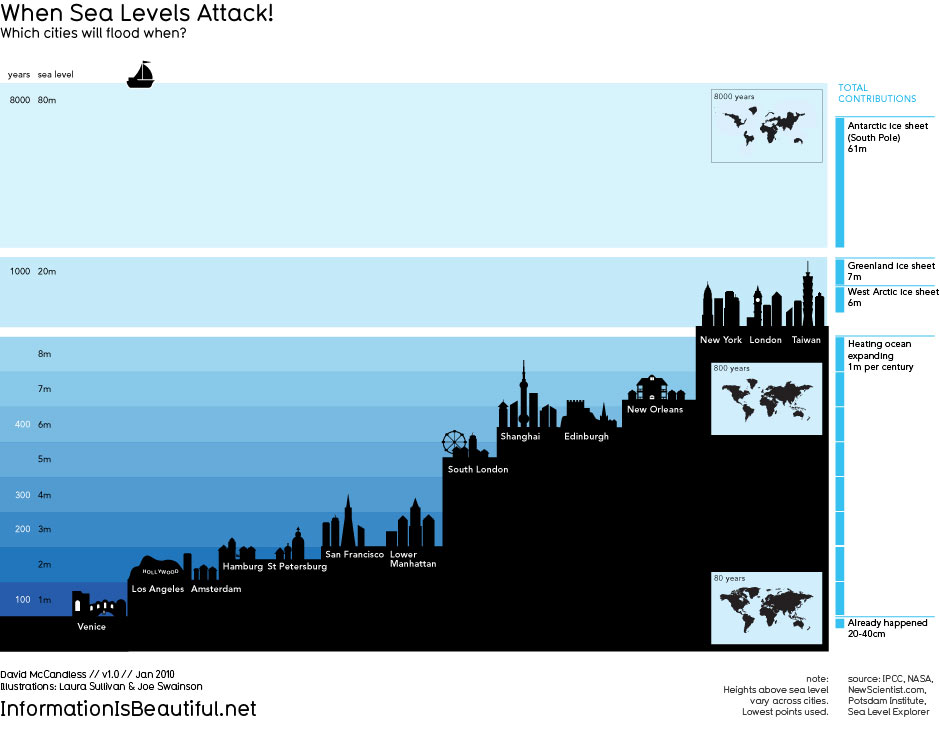
I don't know about you, but I'm getting a little impatient with the inaccuracies of a group of like-minded people who focus more on climate issues than energy issues. Take a look at this nonsensical chart (from the Guardian), which seems to show that San Francisco will go underwater if sea level rises another two meters, whereas New Orleans will apparently not go under water unless sea level rises another six meters.

I have been to San Francisco several times, and if sea level rises another two meters, you are going to lose the Embarcado, but most of the city will be high and dry. The highest point in the city is nearly 300 meters up, and Lafayette Park is around 100 meters above sea level -- smack dab in the middle of town.

In comparison, Lafayette Park in New Orleans is probably less than a meter above sea level, and I honestly don't believe that any piece of dirt in the city -- including all of the levees -- are anywhere close to six meters above sea level. You have to sit on the roof of the Superdome to get that high.

What a stupid chart.